
Looking to sell raw land in Arkansas? Raw land is undeveloped acreage with no utilities, no improvements, and often no platted lot lines. A vacant lot is a small, surveyed parcel within a subdivision or town, usually with road frontage and nearby utilities. Vacant lots tend to sell faster because the buyer pool is larger. Raw land often sells for more in total dollars because of acreage, but for less per acre. If you want to sell raw land or a vacant lot in Arkansas, Veteran Land Buyers buys both as-is, for cash, with no commissions or fees. Call (870) 533-5263 or request a cash offer for your Arkansas land.
Landowners call our Newport office every week and describe the same parcel two different ways. One person says, “I have a lot in Cherokee Village.” The next says, “I have some raw ground outside Tuckerman.” Both want the same thing: to sell raw land without a long listing, surveys they have to pay for, or a buyer who backs out at the last minute.
The words matter more than most people expect. “Raw land” and “vacant lot” attract different buyers, get valued with different methods, and come with different paperwork. This guide explains the difference in plain language, shows which type usually sells faster or for more, walks through regional examples across Arkansas, and lays out how we buy both.
Key Takeaways
- Raw land is undeveloped acreage with no utilities or recorded plat; a vacant lot is a small, surveyed parcel inside a subdivision or town, usually with street frontage and utilities nearby.
- Check your deed or tax bill to tell them apart: “Lot, Block, Unit” means a vacant lot, while “section, township, and range” or “metes and bounds” means raw land.
- Vacant lots usually sell faster on the open market, but lots in oversupplied POA communities with heavy dues can sit for years.
- Vacant lots bring more per acre; raw land usually brings more in total dollars. Net proceeds after commissions, dues, back taxes, and holding costs matter most.
- Access, utilities, flood zone, title condition, and POA status move the value of either parcel type up or down.
- Veteran Land Buyers purchases both raw land and vacant lots anywhere in Arkansas as-is, for cash, with no commissions or fees. Once clear title is confirmed, closing may take approximately 3 to 4 weeks. Call (870) 533-5263. Se Habla Español.
Raw Land vs. Vacant Lot: What to Know Before You Sell Raw Land in Arkansas
The short version: raw land is defined by what it lacks (development), and a vacant lot is defined by where it sits (inside a platted subdivision or town grid). Here is the side-by-side view.
| Feature | Raw Land | Vacant Lot |
| Typical size | Several acres to hundreds of acres | A fraction of an acre to a few acres |
| Location | Rural or edge of town | Inside a subdivision, city limits, or a property owners association (POA) |
| Legal description | Metes and bounds or section, township, and range | Lot and block number on a recorded plat |
| Utilities | Usually none on site; may be far from the road | Often at the street or within reach |
| Road access | County road, private easement, or sometimes none | Platted street frontage in most cases |
| Improvements | None, or old fencing, a pond, timber, or a well | None, though the lot may be cleared or graded |
| Carrying costs | Property tax; sometimes timber or ag assessments | Property tax plus POA or city assessments in many subdivisions |
| Common buyers | Farmers, hunters, timber companies, investors, homesteaders | Builders, neighbors, small investors, out-of-state buyers |
What Counts as Raw Land?
Raw land is acreage in its natural or near-natural state. Nobody has run water, sewer, or power to it. There is no recorded subdivision plat dividing it into numbered lots. The legal description usually reads like a survey narrative or a section reference.
In Arkansas, raw land shows up as:
- Cutover or standing timber tracts in the Ouachitas and the southern timberlands
- Delta acreage that is too small, too wet, or too irregular to farm efficiently
- Ozark hillside parcels bought decades ago for a cabin that never got built
- Family land split among heirs where nobody lives nearby
- Pasture that has grown up in brush after the cattle were sold
A tract does not stop being raw land just because it has a gate, an old fence line, or a farm pond. Buyers still treat it as undeveloped because it takes real money to make it usable.
What Counts as a Vacant Lot?
A vacant lot is a parcel that was created by a recorded plat. Someone has already divided a larger tract into lots, dedicated streets, and often installed utilities. The lot simply has no structure on it yet.
Arkansas has an unusually large supply of vacant lots because of the big planned communities developed from the 1960s onward. Think of Cherokee Village, Horseshoe Bend, Fairfield Bay, Holiday Island, Hot Springs Village, and Bella Vista, along with thousands of smaller subdivisions around Little Rock, Jonesboro, Conway, and Fort Smith. Many of those lots were sold to out-of-state buyers who never built and now pay annual dues on ground they have never seen.
Why Does the Terminology Matter When You Sell Land in Arkansas?
Three practical reasons.
1. It changes who is searching for your property. A hunter typing “40 acres near Cave City” will never see a listing titled “residential lot.” A builder looking for infill lots in Sherwood will skip over “raw acreage.” Using the right label puts your parcel in front of the right people.
2. It changes how the property is valued. Raw land is priced per acre and adjusted for access, timber, soil, and flood exposure. Vacant lots are priced against nearby lot sales and adjusted for utilities, POA dues, and buildability. Applying the wrong method produces a wrong number, usually a disappointing one.
3. It changes the paperwork. A vacant lot inside a POA usually needs a dues status letter or estoppel from the association before closing. Raw land may instead require an easement review, a timber deed check, or a flood zone determination.
If you are unsure which category your parcel falls into, look at the legal description on your tax bill or deed. “Lot 14, Block 3, Unit 7” means a vacant lot. “The NE quarter of the SW quarter of Section 22” means raw land.
Which Sells Faster, Raw Land or a Vacant Lot?
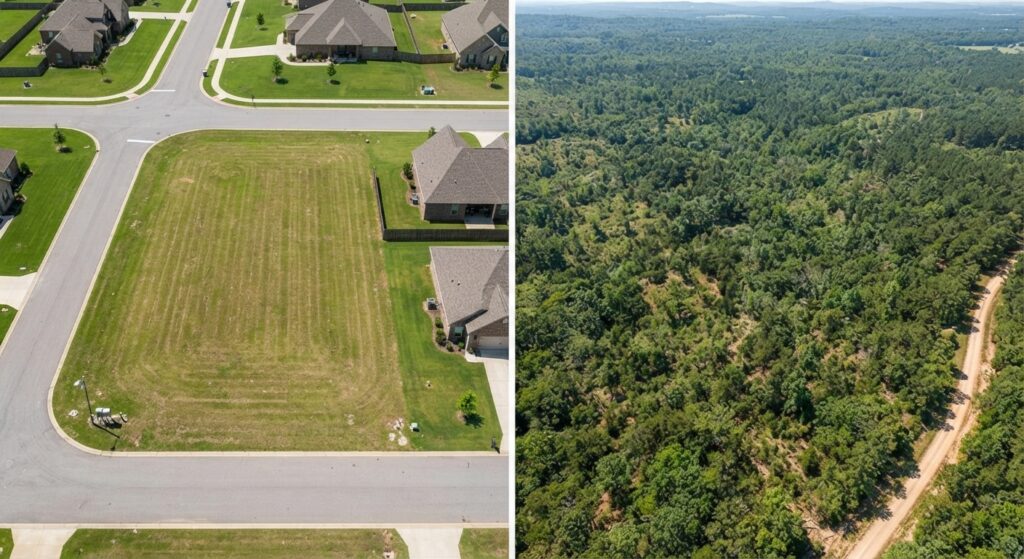
On the open market, vacant lots typically move faster. The buyer pool is bigger, financing is easier to arrange for a small purchase, and there are fewer unknowns to investigate. A buildable lot with water at the street in a growing area like Cabot, Bryant, or Greenbrier can attract interest within weeks.
Raw land takes longer for a simple reason: fewer people want twenty acres of brush with a questionable easement than want a quarter-acre lot on a paved street. Rural tracts also sit further from lenders’ comfort zones, so many buyers need cash or owner financing.
There is a major exception. Vacant lots in older POA subdivisions can be the slowest-selling property in the state. When a community has thousands of undeveloped lots and heavy annual dues, supply overwhelms demand. Owners in those areas sometimes list for years without a serious offer, and some end up letting the lot go to the county for unpaid taxes.
| Scenario | Typical Market Speed | Why |
| Buildable lot with utilities near a growing town | Fast | Builders and end users compete for it |
| Lot in a large POA with heavy dues and thousands of unbuilt lots | Very slow | Supply far exceeds demand; dues scare buyers off |
| Raw acreage with county road frontage and decent access | Moderate | Steady hunter, farmer, and homesteader interest |
| Landlocked raw acreage or floodplain tract | Slow | Access and usability questions shrink the buyer pool |
| Any of the above sold to a direct cash buyer | Weeks, not months | No listing period, no financing contingency, no showings |
A direct cash sale flattens these differences. Speed no longer depends on finding the right buyer because the buyer is already at the table.
Which Sells for More Money?
This is where owners get confused, because the answer depends on whether you are measuring per acre or in total.
- Per acre, vacant lots almost always win. A small lot with street access and utilities commands a much higher price per square foot than rural acreage because someone has already paid to develop it.
- In total dollars, raw land usually wins. Forty acres of decent Ozark ground will bring in more than one subdivision lot, even though the lot costs more per acre.
- Net proceeds are what matter. Subtract listing commissions, survey costs, POA dues owed at closing, back taxes, and months of holding costs. A lot that sells for a higher headline price can net less than a fast, clean sale of the same parcel to a cash buyer.
What Factors Push Value Up or Down?
Whether your parcel is raw land or a vacant lot, these are the levers that move an offer. Our guide covers the full method for determining what your Arkansas land is worth and how a fair cash offer is calculated.
| Factor | Raises Value | Lowers Value |
| Access | Frontage on a maintained county road or paved street | No legal access or a disputed easement |
| Utilities | Power, water, and sewer at the boundary | Miles from the nearest line; septic not feasible |
| Topography | Gently rolling or level, well-drained | Steep, rocky, or holds water |
| Flood zone | Outside the mapped floodplain | Inside a FEMA special flood hazard area |
| Timber or ag use | Merchantable timber, productive soils, or a farm lease | Recently cut over with no regrowth value |
| Title condition | Clear title, one owner, taxes current | Multiple heirs, missing deeds, back taxes, liens |
| POA status (lots) | Dues current, active community with amenities | Years of unpaid dues, struggling association |
| Nearby demand | Close to a growing town, lake, or highway | Remote with little recent sales activity |
How to Sell Raw Land in Arkansas: What Vacant Lot and Acreage Sales Look Like Statewide
Arkansas is really five or six different land markets. One region’s dominant parcel type is rare in another, and buyers’ questions change accordingly. These examples are typical of what we see, not descriptions of specific transactions.
| Region | Common Raw Land | Common Vacant Lots | What Buyers Ask About |
| Northeast Delta (Jackson, Craighead, Greene, Mississippi counties) | Odd-shaped field corners, drainage ditch remnants, wooded bottomland near the Cache and White rivers | Small town lots in Newport, Tuckerman, Paragould, Blytheville, and Osceola | Flood history, whether the tract can be farmed, ditch assessments, back taxes |
| Central Arkansas (Pulaski, Saline, Faulkner, Lonoke counties) | Edge of town acreage between Little Rock and Conway, wooded tracts near Lake Maumelle | Infill lots in Little Rock, North Little Rock, Sherwood, Jacksonville, Benton, and Cabot | Zoning, utility taps, whether the lot is buildable, city code liens |
| Ozarks (Baxter, Marion, Sharp, Fulton, Izard counties) | Hillside and hollow acreage, river frontage tracts near the White and Spring rivers | Thousands of POA lots in Cherokee Village, Horseshoe Bend, and lake communities near Mountain Home | Dues balance, road maintenance, septic feasibility on rocky ground, access |
| Ouachitas (Garland, Montgomery, Polk, Saline counties) | Timber tracts, mountain acreage near national forest boundaries | Lots in and around Hot Springs and Hot Springs Village | Timber value, slope, POA rules, well and septic options |
| Southern Timberlands (Union, Ashley, Bradley, Drew, Columbia counties) | Pine plantation remnants, cutover tracts, hunting land near El Dorado, Crossett, and Warren | Small town lots and rural subdivision parcels | Mineral rights, timber deeds, hunting lease status, access through neighboring timber company land |
| Northwest and River Valley (Benton, Washington, Crawford, Sebastian counties) | Pasture converting to development land, creek bottom acreage | Bella Vista POA lots, subdivision lots around Fayetteville, Springdale, and Fort Smith | Development pressure, POA dues, buildability, road frontage |
Two patterns stand out from our own buying across these regions. First, the single most common seller of vacant lots we talk to is an out-of-state owner who inherited or bought a POA lot years ago and is tired of paying dues. Second, the most common raw land seller is a family member handling ground split among heirs, where nobody wants to manage it, and nobody wants to force a sale. Both situations are solvable and exactly what a direct buyer is built for.
How Do Veteran Land Buyers Buy Both Raw Land and Vacant Lots?
We are a veteran-owned land buying company based in Newport, Arkansas, and we buy undeveloped land across the state. We do not specialize in one parcel type over the other. A quarter-acre lot in Sherwood and eighty acres of timber outside Warren go through the same process.
4. Tell us about the parcel. Use the short form on our Sell My Land in Arkansas page or call (870) 533-5263. The parcel number from your tax bill is enough to get started.
5. We research it. We look at access, flood maps, comparable sales, tax status, and, for lots, the POA situation. You do not pay for a survey, an appraisal, or any inspection. Our page on how we determine your land’s cash offer explains exactly what we look at.
6. You receive a written cash offer. There is no obligation and no pressure. Take time to compare it with other options.
7. We handle title and closing. A licensed title company or attorney closes the transaction. We cover standard closing costs, with no commissions or hidden fees.
On timing, we are straightforward: the closing date depends on several factors, including the land title status, document review, and required paperwork. Once we receive confirmation of clear title, the process may take approximately 3 to 4 weeks. Parcels with heir issues, missing deeds, or unpaid POA balances can take longer, but we work through those issues rather than walk away.
What Kinds of Undeveloped Land Do You Buy?
- Raw acreage of any size, with or without road access
- Vacant subdivision lots, including POA lots with dues owed
- Inherited land, including parcels with multiple heirs
- Land with back taxes or that is close to tax forfeiture
- Timber tracts, hunting ground, and pasture
- Floodplain, wetland, and other hard-to-sell parcels
Wondering whether a direct sale beats a traditional listing for your situation? Our comparison of selling land to a cash buyer versus listing with a realtor in Arkansas walks through the trade-offs honestly, including when a listing still makes sense.
What Should You Gather Before Selling Undeveloped Land in Arkansas?
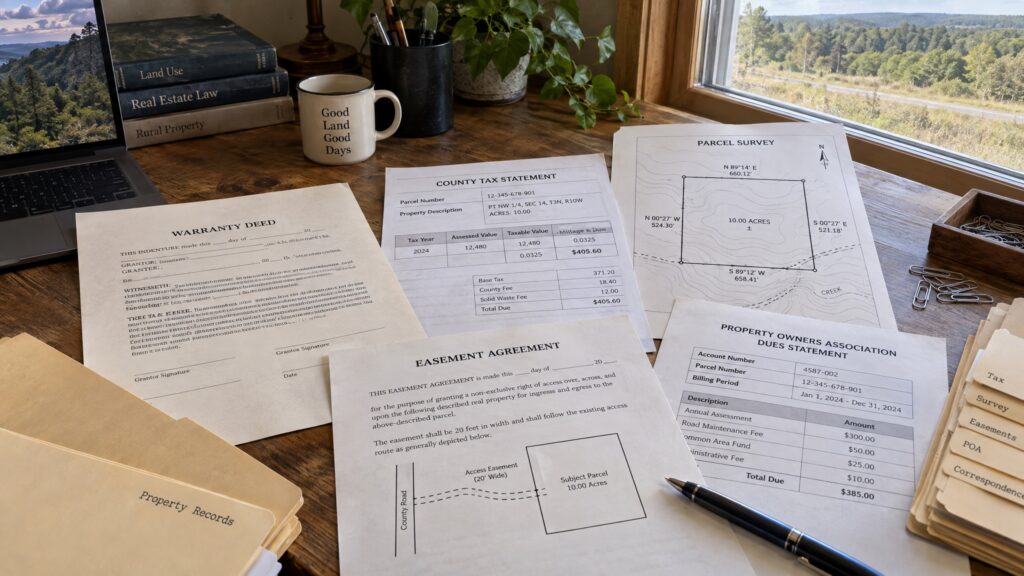
You do not need everything on this list to request an offer, but having it ready speeds up title work.
| Item | Raw Land | Vacant Lot | Where to Find It |
| Parcel number and legal description | Yes | Yes | County tax statement or assessor website |
| Copy of the deed | Yes | Yes | County circuit clerk or your closing papers |
| Property tax status | Yes | Yes | County collector; check for delinquent years |
| Easement or access documents | Often | Rarely | Deed records; sometimes only a handshake agreement exists, and that is worth mentioning |
| Timber deed or lease | Sometimes | No | Deed records or your files |
| POA dues statement | No | Yes | The association office |
| Probate or heirship paperwork | If inherited | If inherited | Probate court or the family attorney |
| Any old survey | Helpful | Helpful | Your files; not required |
If a document is missing, tell us. Missing paperwork is one of the most common reasons landowners put off selling, and it is usually fixable during title work.
Frequently Asked Questions
What counts as raw land?
Raw land is acreage with no utilities, no structures, and no recorded subdivision plat. It is described by survey or section reference rather than lot and block. Old fencing, a pond, or standing timber does not change that classification.
Do vacant lots sell for less?
Per acre, vacant lots usually sell for more than raw land because the development work is already done. In total dollars, a single lot often brings less than a larger raw tract. Lots in oversupplied POA subdivisions with heavy dues can sell for very little on the open market because there are far more lots than buyers.
Do you buy both raw land and vacant lots?
Yes. Veteran Land Buyers buys raw acreage and vacant lots anywhere in Arkansas, as-is, for cash, with no commissions or fees. That includes POA lots with dues owed, inherited parcels, landlocked tracts, and land with back taxes.
Do I need a survey to sell raw land in Arkansas?
Not to sell to us. We work from the existing legal description and order a survey ourselves only if title work requires it. You are never asked to pay for one.
Can I sell a vacant lot if I owe POA dues?
Yes. We typically settle the unpaid balance from the sale proceeds at closing. Tell us the approximate amount owed so we can factor it in up front.
Ready to Sell Raw Land or a Vacant Lot in Arkansas?
Get a no-obligation cash offer in writing. Fill out the short form or call us directly. We buy raw land and vacant lots across Arkansas, as-is, with no commissions, fees, or repairs or cleanup required.
Why Landowners Trust Veteran Land Buyers
Veteran Land Buyers is a veteran-owned and operated company headquartered at 416 2nd St, Ste G, Newport, AR 72112. We bring the same discipline, transparency, and follow-through to land buying that our team learned in service. We explain every offer, handle every closing through a licensed title company or attorney, and never charge a seller a fee.
Veteran Land Buyers
Call or text: (870) 533-5263
Se Habla Español. Hablamos su idioma. Compramos terrenos en Arkansas.
This article is educational and is not legal, tax, or financial advice. For questions about your specific situation, consult a licensed Arkansas attorney or tax professional.

JP Kilduff is the Co-Founder and Chief Operating Officer at Veteran Land Buyers. He started investing in to real estate and communities in 2016. He has worked with hundreds of families purchasing their unwanted land across Arkansas, South Carolina and Florida. When JP is not buying and selling land you can find him on the local basketball court or playing disc golf.


