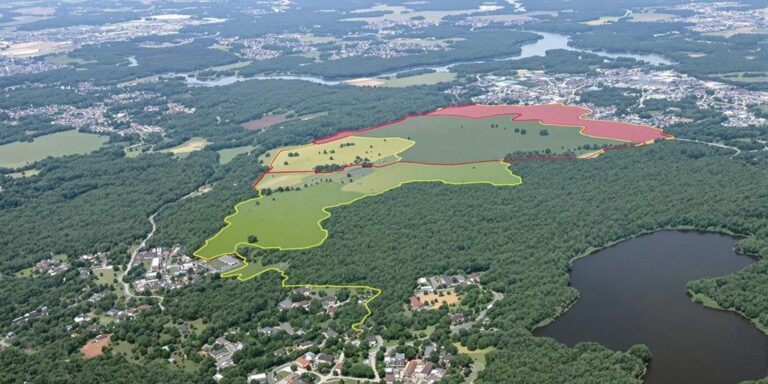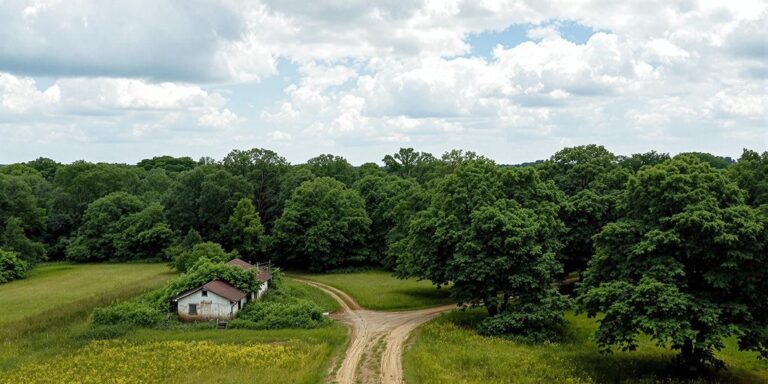
How much is my land worth? Your Arkansas land’s value depends on several specific factors, including its location, acreage, legal access, terrain, available utilities, timber, and the recent sale prices of comparable properties nearby.
No single official value exists for a parcel. A county-assessed value, professional appraisal, listing price, and cash offer are different figures used for different purposes. This guide from the veteran-owned team at Veteran Land Buyers explains what affects Arkansas land value and walks you through how we calculate a fair cash offer, helping you evaluate any offer with confidence.
Key Takeaways
- Legal access is one of the biggest determinants of Arkansas land value. Land that has deeded road frontage or a recorded easement is considerably more useful and marketable than landlocked property, and unresolved access problems can result in large discounts.
- Recent comparable sales, not tax assessments or online listing prices, are the best indicator of market value. The best way to determine land value is to compare it with similar plots that have actually sold nearby, then make allowances for differences in size, ground conditions, facilities, timber, and access.
- The county-assessed value differs from the market value. Property tax assessments in Arkansas may be outdated compared to current market values and are based on general models that may not account for details such as flood risk, timber value, road condition, or easement rights.
- An acceptable cash proposal gives up some potential profit in exchange for speed, certainty, and lower seller expenses. Typical cash buyers factor in closing costs, title work, holding costs, cleanup, resale risk, and the time it will take to resell the property; in exchange, the seller gets a fixed price without paying commissions or closing fees.
- The value of the land can be greatly affected by its physical features. A buyer’s willingness to pay depends on factors such as usable acreage, terrain, flood-zone status, shape, utilities, timber volume, zoning restrictions, and title condition. Parcels of two similar sizes in the same county can have very different values.
- Land values differ greatly across Arkansas. Demand for properties varies from one area to another: growth in Northwest Arkansas and Central Arkansas can boost values, lake access fuels demand in the Ozark area, fertile soils matter in the Delta, and timber condition strongly affects property values in South Arkansas.
- A written cash offer includes an actual selling price, whereas an appraisal has a different function. A paid appraisal is useful in estates, divorces, lending, or tax disputes; but for an owner who wants to sell, a written, no-obligation offer shows how much a buyer is willing to pay right now.
- Transparency matters when assessing a land buyer. Sellers must find out how the offer was worked out and provide any facts that might influence the value—for example, the results of a survey, the existence of a recorded easement, merchantable timber, or the availability of utilities. A reasonable buyer should be prepared to reconsider the offer if new, verifiable information changes the assessment.
What’s My Land Worth?
- The main factors affecting value are legal road access, location or county, usable acreage, terrain, utilities, and timber; indeed, access alone can dramatically affect value.
- The best guide is the most recent sales of similar plots of land in your county, not the tax bill and not the asking prices you see online.
- The county-assessed value is not the same as market value; assessments in Arkansas are intended for tax purposes and often fail to keep up with, or differ from, the actual price at which land is traded.
- A fair cash price is the market value on a compensation basis, taking into account the buyer’s costs, risk, and the time before resale—in exchange for speed, certainty, and no seller’s fees.
- Fastest way to a real number: get a free written offer from Veteran Land Buyers with no obligation. Call (870) 533-5263. Se habla español.
What Decides the Value of Land in Arkansas?
The value of two 40-acre plots in the same county can vary by about five figures. The following are the factors that actually cause this difference, approximately in order of their impact in rural Arkansas:
| Factor | Why It Matters | Typical Impact on Value |
| Legal access | Land with deeded road frontage or a recorded easement is usable; landlocked land is not, until access is resolved. | Major — landlocked parcels often sell at steep discounts |
| Location & county | Proximity to growing towns, lakes, and highways drives demand. Land value in Arkansas varies widely between, say, a Baxter County lake area and a remote Delta section. | Major |
| Acreage & shape | Per-acre price usually falls as acreage rises. Odd, narrow, or fragmented shapes reduce usability. | Major |
| Terrain & usable land | Buildable, walkable ground is worth more than bluffs, ravines, or year-round wet bottoms. | Moderate to major |
| Flood zone status | FEMA-mapped floodplain limits building and financing options. | Moderate |
| Utilities | Power, water, and internet at or near the road lower a future owner’s development cost. | Moderate |
| Timber | Mature, merchantable pine or hardwood adds harvestable value; recently cutover land subtracts appeal. | Moderate — can be significant on larger tracts |
| Zoning & restrictions | Most rural Arkansas land is unzoned, but subdivision covenants or conservation easements can limit use. | Varies |
| Title condition | Clean title sells at full value; unresolved heirs, liens, or back taxes narrow the buyer pool. | Varies — fixable, but costs time or money |
Why is it such a major issue to have legal access?
Since no such right exists, a buyer cannot legally access the property. Each week we look at properties where the owner assumes the dirt trail they’ve always used constitutes a legal easement, even though the county records indicate otherwise. That said, the land can still be sold; specialists like us buy landlocked properties and do the access research ourselves. Yet it is the most common reason the seller’s price expectations and the market’s response don’t align.
What is the way of finding out what your land is really worth?
You have four practical options, each producing a different kind of number:
| Method | Cost to You | What You Get | Best For |
| County assessed value | Free (on your tax statement) | A taxation figure — often well off from market value | A starting reference only |
| Professional appraisal | Roughly $300–$1,000+ for rural land | A formal, defensible opinion of market value | Estates, divorces, disputes, lending |
| Agent’s market analysis | Usually free (expects a listing) | A suggested listing price — not a guaranteed sale price | Sellers planning to list and wait |
| Direct cash offer | Free, no obligation | An actual purchase price someone will pay, in writing | Sellers who want a real, actionable number fast |
Should I get a paid appraisal of my land in Arkansas if I am selling it?
Most of the time it doesn’t. A formal land appraisal from Arkansas is reasonable whenever you need a defensible figure for legal or lending reasons, such as settling an estate, dividing assets, or disputing a tax assessment. If you aim to sell, a paid appraisal will tell you the land’s theoretical value; it won’t bring you a buyer. A written cash offer, on the other hand, is free and gives you a price that you can actually agree to. There’s no obstacle to doing both and then comparing them; we have no problem with being compared, and we’re willing to explain our figures regardless of the situation.
How do Veteran Land Buyers work out a fair cash offer for land?
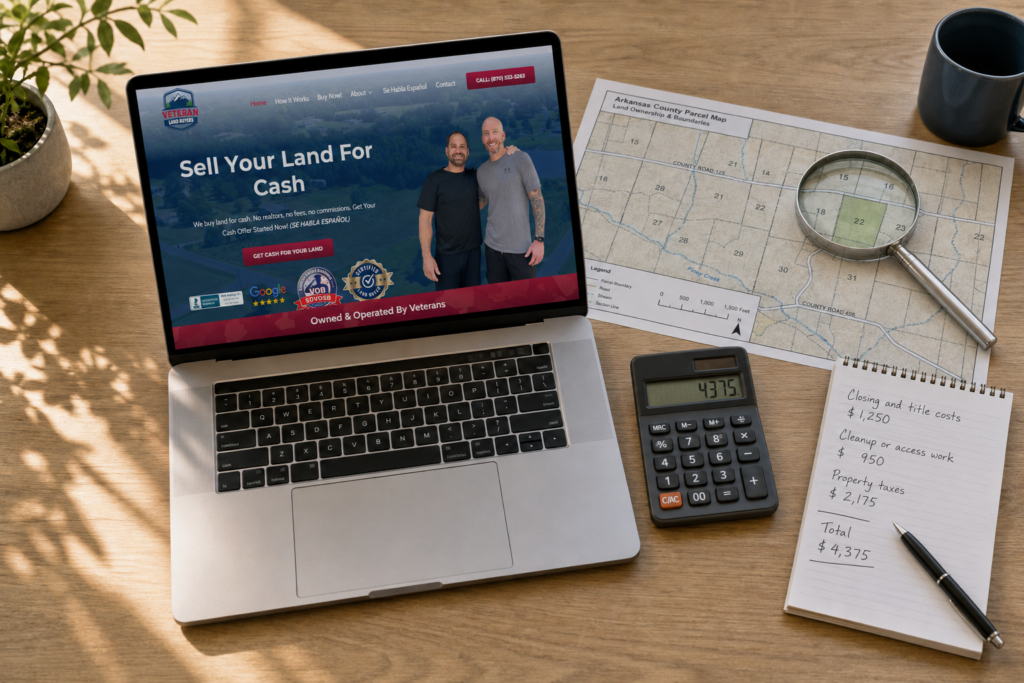
Most companies that say they buy land keep their figures a secret. We prefer to show you the entire process because we want to work with a well-informed seller. The following is what takes place after you submit your parcel:
- Step 1 — Pull the record. We look up your parcel in the county assessor and recorder systems to confirm acreage, legal description, ownership history, and tax status.
- Step 2 — Study the ground. Using GIS mapping, aerial imagery, and FEMA flood maps, we assess terrain, tree cover, water features, access points, and how much of the acreage is genuinely usable.
- Step 3 — Run the comps. We find recently completed sales of similar parcels in your county and adjust for differences—access, size, terrain, utilities, timber.
- Step 4 — Subtract our real costs and risk. Closing and title costs (we pay them), any cleanup or access work, property taxes we’ll carry, and the months it may take us to resell.
- Step 5 — Put it in writing. You get a firm written offer — not a teaser number that shrinks at the closing table. If you ask how we got there, we’ll walk you through it line by line.
That’s an important point. In our experience, the sellers who become our most valuable referral sources are the ones who ask the toughest questions at the beginning. If you’d like to see how the offer fits into the entire selling process, our guide on how to sell land for cash outlines the full timeline, and our Sell My Land in Arkansas hub gives you the overall view.
Does a Cash Offer Fall Below Full Retail Value?
The honest answer is that the buyer ends up paying or bearing all the costs that you would otherwise have to pay or risk. If we buy your land, we assume responsibility for the closing costs, the holding taxes, the marketing needed to resell it, and the risk that the market will weaken before we decide to resell. In turn, you give up a portion of the retail value in exchange for a guaranteed price, a quick completion, and no fees. In some cases, this kind of deal isn’t appropriate, and we’ll admit that. However, for owners of inherited land, land in a remote area, or land that’s difficult to list, it often results in a better net return. Our analysis of cash offers versus listing your land includes the actual calculation.
What Makes My Offer Different from the County-Assessed Value?
This is the question we are asked most frequently, which is why it warrants its own section. In Arkansas, county assessments are used for working out your property tax, not for predicting the sale price. There are three reasons why the figures differ:
- Assessments are often behind the market. Since counties carry out reappraisals on a multi-year basis, the assessed values can be years behind or ahead of the market.
- When assessing property values, judges consider the details in bulk. Large-scale appraisal models cannot account for the features most important in determining the value of rural land, such as a washed-out road, a stand of mature white oaks, or a neighbor’s recorded easement.
- Valuations based on use. In Arkansas, agricultural and timber land is usually valued by productivity rather than market value, which can make the assessed amount much lower (or, in some cases, higher) than the price buyers pay.
So whether your cash offer is higher or lower than the assessor’s figure, neither is incorrect, since each answers a different question. Your offer answers the one question that really counts when selling a property: how much someone will actually pay in writing today?
What is the variation in land value throughout the different regions of Arkansas?
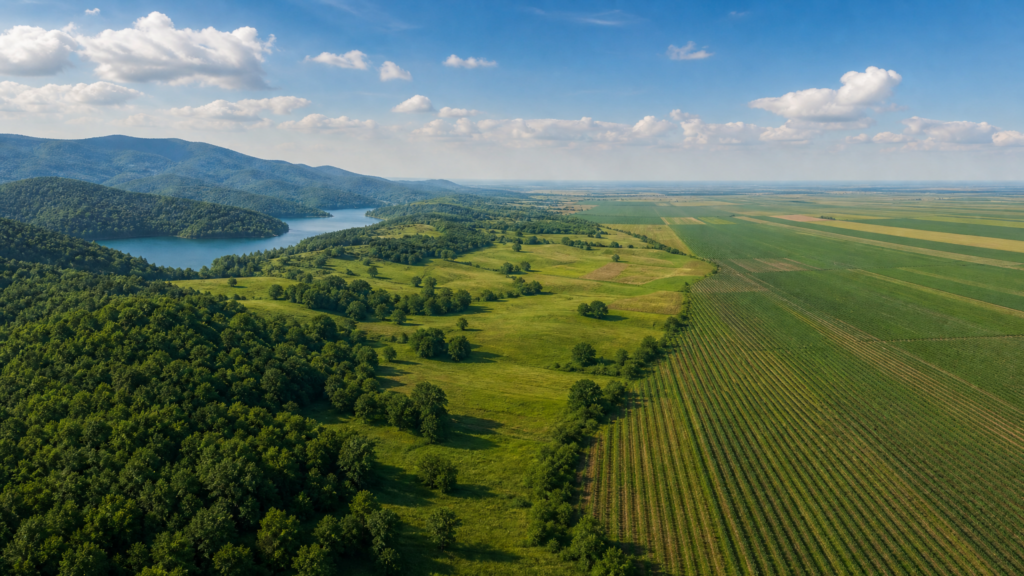
We incorporate location into each computation. The broad patterns that we observe throughout the state are:
- In Northwest Arkansas (Benton, Washington, Madison): demand is highest, driven by population growth; land close to the metropolitan area sells at a premium.
- In the Ozark lake and river area (in the counties of Baxter, Marion, Izard, and Stone), demand for recreational and retirement purposes is steady; value increases with access to or views of the water but decreases with steep terrain.
- In northeast Arkansas (in the counties of Craighead, Greene, Lawrence, and Jackson), a mix of farmland and expanding towns around Jonesboro drives value; row-crop land is selected based on soil quality and drainage.
- In the Delta area (in Mississippi, Phillips, Lee, and Poinsett), productive farmland retains its value adequately, while smaller plots not used for farming change more slowly and depend on demand from hunting.
- In the southern part of Arkansas, comprising the counties of Union, Ouachita, Bradley, and Calhoun, value follows the stage of the timber—mature forests add real value, while recently cut areas lose value.
- The acreage in Central Arkansas—covering Pulaski, Saline, Faulkner, and White—takes advantage of the demand from Little Rock, with utilities and road frontage being the most important factors.
These are patterns, not prices, since the parcel number is derived from comparable properties. A free evaluation is exactly what this information is for.
What reasons should you have for putting confidence in a company that is owned by veterans when it comes to valuing your land?
Veteran Land Buyers is veteran-owned and based in Newport, Arkansas. We have set out our valuation process in writing on a public web page since transparency is the standard we follow and the one by which we operate the company. In practice, that looks like this:
- We’ll show you our work. If you ask us how we got your number, we’ll give you an actual answer, not a script.
- We never engage in re-trading; the amount stated in the offer that you accept is the amount you get, and we cover all the closing costs.
- We’ll let you know if we aren’t the suitable buyer. With a prime road-frontage parcel and no urgency? We’ve instructed the sellers to list it. That honesty loses us some deals but brings us referrals.
- We know the circumstances surrounding the sales. A number of our sellers are other veterans, widows who are still living, and heirs who live in different states. We have helped families assess the value of land they had never seen, doing so in a patient, stress-free manner.
Frequently Asked Questions About Land Value and Cash Offers
Is the offer negotiable?
Certainly! Provided that it’s reasonable. Since our offers are based on comparative data and actual costs, there are limits to how far any figure can vary. However, if you have information we overlooked, such as a recorded easement, merchantable timber, a recent survey, or utilities we missed—let us know. We’ll rework the evaluation with the new information, and offers change when the facts change.
Will you charge for the valuation?
Not at all. Our property research and the written cash offer are entirely free, and there is no obligation to take them. We never charge sellers any fees at any stage: no valuation fee, no commissions, no closing costs. Be careful if a buyer asks you to pay for an ‘evaluation’ or ‘processing’ before closing; genuine cash buyers won’t do that.
What could cause my offer to be different from the county-assessed value?
Since the assessed value is used to calculate property taxes, not determine the sale price, Arkansas counties carry out reappraisals on a multi-year basis, use mass-appraisal models, and generally assess agricultural and timber land according to its use rather than its market value. A cash offer is based on recent actual sales of similar parcels, with adjustments for the access, terrain, and condition of your land. So the two figures usually differ in one direction or the other.
Find Out What Your Land Is Worth — Free, In Writing, No Obligation
You might try to work out your land’s value, pay for an appraisal, or wait months while the property is listed to find out what the market considers it to be. Alternatively, you can have a real, written figure in your hands in about 48 hours—without having to pay. If you don’t accept the offer, you will owe us nothing and will still be in a better position than before when it comes to knowing your property’s value.
Request your free land valuation and cash offer:
- Today you can book a discovery call for a free, no-obligation consultation by clicking on the link: https://veteranlandbuyers.com/sellnow/
- Call or text: (870) 533-5263
- Se habla español. Llámenos hoy para saber cuánto vale su terreno.
Owned by veterans. Free quotes and written offers within 24 to 48 hours—without any fees ever.

JP Kilduff is the Co-Founder and Chief Operating Officer at Veteran Land Buyers. He started investing in to real estate and communities in 2016. He has worked with hundreds of families purchasing their unwanted land across Arkansas, South Carolina and Florida. When JP is not buying and selling land you can find him on the local basketball court or playing disc golf.