A fair cash offer for land in Arkansas is a net, as-is price that reflects what your parcel can realistically resell for in its county, minus the buyer’s holding costs, closing costs, and margin. Most fair offers land somewhere below full retail list price, but they come with no commissions, no repairs, no appraisal contingencies, and a closing measured in days rather than months. The honest way to judge an offer is not the headline number. It is the money you actually keep, on the date you actually keep it.
Landowners across Arkansas ask us the same question in the first two minutes of almost every call: is this number fair? It is the right question. When you sell land for cash to a direct buyer, you are trading some top-end price for speed and certainty, and you deserve to know exactly what that trade looks like before you sign anything.
This guide explains how buyers build a cash offer for land, which features of your parcel move the number up or down, why a cash offer differs from a listing price, and the questions that separate a transparent buyer from a bad one.
Key Takeaways
- A fair cash offer for land in Arkansas is a net, as-is price based on what your parcel can realistically resell for in its county, minus the buyer’s holding costs, closing costs, and margin.
- Judge an offer by the money you actually keep and the date you keep it, not by the headline number. Compare net proceeds against a listing after commission, closing costs, and carrying costs.
- County demand and legal access move the number the most. Landlocked parcels still sell, only at a discount.
- Back taxes, liens, and clouded title rarely stop a sale. They are usually paid from your proceeds at closing, though they can stretch the timeline.
- Most straightforward Arkansas parcels close in roughly two to four weeks, and title work sets the pace.
- Ask how the number was built, who pays closing costs, and whether the offer is truly no obligation. Pressure to sign the same day, upfront fees, or refusal to use a title company are warning signs.
What Does a Cash Offer for Land Actually Mean?
A cash offer for land means the buyer purchases with their own funds or committed capital rather than a mortgage. No lender means no loan underwriting, no lender-ordered appraisal, and no financing contingency that can collapse the deal three weeks in.
For a landowner, that distinction matters more than it does in a house sale. Vacant land is difficult to finance. Many banks will not lend on raw acreage at all, or they demand large down payments and short terms. That is a core reason listed land sits on the market for months while buyer after buyer fails to secure funding.
A genuine cash offer for land usually includes these terms:
- As-is purchase. No clearing, surveying, perc testing, or cleanup required on your end.
- No commissions. You sell directly, so no listing agent fee is taken from your proceeds.
- Buyer-paid standard closing costs. Most direct land buyers, including us, cover routine closing fees.
- A short, defined timeline. Typically two to four weeks, driven mostly by title work.
- No obligation. Receiving an offer should never commit you to anything.
How Do Land Buyers Evaluate an Arkansas Property?
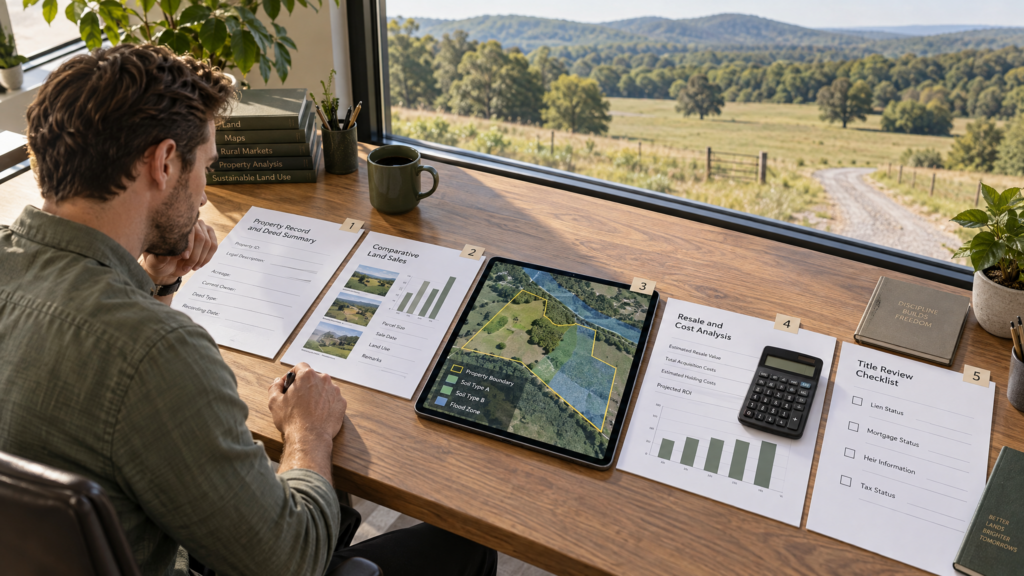
There is no mystery formula, and any buyer who treats their method as a secret should make you wonder. Evaluation follows a repeatable sequence.
Step 1: Confirm What Is Actually Being Sold
The buyer pulls the parcel number, deed, acreage, and legal description from county records. Assessor data and the deed disagree more often than landowners expect, especially on parcels split among heirs decades ago. Verifying this first prevents an offer that has to be revised later.
Step 2: Pull Comparable Sales
The buyer looks at closed sales of similar acreage in the same county and, where possible, the same township. Land comps are thinner than house comps, so a buyer may reach back twelve to twenty-four months and adjust for size, access, and land type.
Step 3: Assess the Parcel Itself
Aerial imagery, county GIS, USDA Web Soil Survey data, and FEMA Flood Map Service Center flood layers tell the buyer how much of your acreage is genuinely usable and what a future owner can do with it.
Step 4: Estimate Resale and Subtract Costs
The buyer projects a realistic resale value and timeline, then subtracts property taxes during the hold, title and closing costs, marketing costs, and a margin. What remains is the offer.
Step 5: Check Title Condition
Liens, judgments, unreleased mortgages, missing heirs, and delinquent taxes do not always kill a sale, but they affect the timeline and sometimes the net. Good buyers surface these early, not at the closing table.
What Factors Affect a Cash Offer for Land in Arkansas?
Two ten-acre parcels in the same county can be worth very different amounts. Here is what drives the spread.
| Factor | Why It Matters | Typical Effect on the Offer |
| County and local demand | Buyer pools differ enormously between a Pulaski County lot and a remote Delta tract | The single largest variable |
| Acreage | Price per acre generally falls as total acreage rises | Small tracts fetch more per acre, large tracts more in total |
| Legal and physical access | Deeded road frontage is the strongest single value driver on rural land | Landlocked parcels sell, but at a meaningful discount |
| Utilities | Power at the road, rural water, and a viable septic area widen the buyer pool | Raises offers on smaller residential-style tracts |
| Terrain and usable land | Slope, wetlands, floodway, and creek bottoms reduce the buildable footprint | Usable acres carry the value, not total acres |
| Timber, tillable ground, or hunting value | Merchantable timber and productive row-crop soils create income potential | Can raise the offer noticeably |
| Taxes, liens, and title | Back taxes and clouded title are payable from proceeds, not disqualifiers | Reduces net, rarely blocks the sale |
| Survey status | Unclear boundaries create uncertainty a buyer has to price in | A recent survey can protect your number |
Why Does Access Matter So Much?
Access is where we see the widest gap between what an owner expects and what the market pays. A family may have driven across a neighbor’s field for forty years without a recorded easement. That habit has no legal weight. When the buyer’s title work shows no recorded access, the parcel’s realistic use narrows to hunting, timber, or a neighbor sale, and the offer follows that reality.
The encouraging part is that this rarely ends a deal. We routinely buy landlocked ground. The offer reflects the access situation rather than pretending it doesn’t exist.
Do Back Taxes Mean You Cannot Sell?
No. Delinquent taxes are one of the most common worries we hear, and one of the least serious obstacles in practice. Arkansas certifies delinquent parcels to the Commissioner of State Lands, and you typically pay the redemption amount from your closing proceeds. Watch the timeline, because a parcel approaching a scheduled tax sale needs to move quickly.
Why Is a Cash Offer Different From a Listing Price?
A listing price is an asking number. A cash offer is a committed number. Comparing them directly is the most common mistake landowners make.
| Consideration | Listing With an Agent | Direct Cash Offer |
| Headline number | Higher asking price | Lower, but firm |
| Commission | Commonly 6 to 10 percent on land | None |
| Seller closing costs | Often shared or negotiated | Usually covered by the buyer |
| Time on market | Frequently several months or longer | Days to a few weeks |
| Carrying costs while waiting | Taxes, insurance, mowing, upkeep | Ends at closing |
| Risk of the deal failing | Financing and inspection contingencies | Minimal, no lender involved |
| Condition requirements | May need survey, clearing, or cleanup | Purchased as-is |
Run your own comparison on paper. Take the list price, subtract commission, subtract your share of closing costs, subtract the taxes and upkeep you will pay across an expected holding period, and apply an honest discount for the chance the first contract falls through. The gap between that net figure and a firm cash number is usually much smaller than the gap between the two headline prices. For a full breakdown of our methodology, see how we determine your land’s cash offer.
What Questions Should You Ask Before Accepting a Cash Offer?
Ask these before you sign. A buyer who answers all of them plainly is a buyer worth working with.
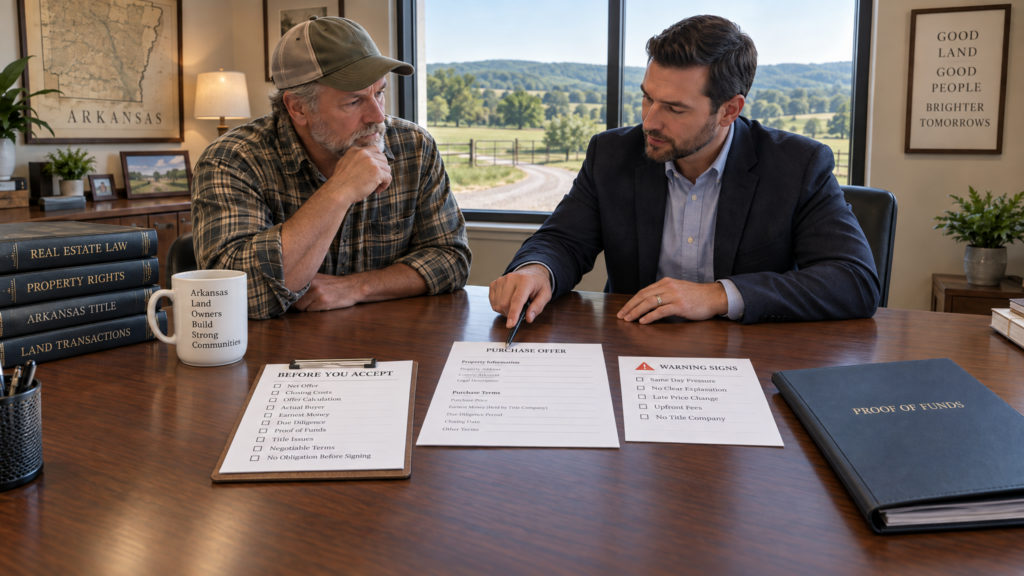
- Is this offer net to me? Clarify exactly which costs come out of your side.
- Who pays closing costs and title fees? Get it in writing, not in conversation.
- How did you arrive at this number? A transparent buyer will walk you through the comps and the deductions.
- Are you the actual buyer, or are you assigning the contract? Both models exist. You have the right to know which one you are in.
- Is there earnest money, and where is it held? Funds should be held by a title company or closing attorney.
- What is your inspection or due diligence period? A very long period with an easy exit is a soft commitment.
- Can you close without financing? Ask for proof of funds.
- What happens if title problems appear? Ask whether the price changes or the timeline simply extends.
- Is the offer negotiable? If you have information the buyer lacks, such as recent timber cruise data or a recorded easement, share it.
- Am I obligated in any way by accepting a written offer for review? The answer should be no until you sign a purchase agreement.
What Are the Warning Signs of an Unfair Offer?
- Pressure to sign the same day the offer arrives.
- Refusal to explain how the number was built.
- A price that changes late in the process without a documented title or survey reason.
- Requests for upfront fees of any kind. A legitimate land buyer never charges you to make an offer.
- No willingness to close through a title company or closing attorney.
How Do Veteran Land Buyers Evaluate Arkansas Land?
We are a veteran-owned company based at 416 2nd St, Ste G, Newport, AR 72112, in Jackson County. That location shapes how we work. We know the difference between Delta gumbo and a sandy ridge, why a duck-hole tract in the flyway prices differently than the same acreage two counties west, and how quickly a Pulaski County infill lot moves compared to remote timber ground.
Our review process is deliberately plain:
- You tell us the parcel. A parcel number, address, or rough location is enough to start.
- We verify records. Deed, acreage, assessed values, and tax status through county sources.
- We study the land remotely. Aerials, GIS layers, soils, flood zones, and access.
- We pull local comps. We start with the same county, then adjust for acreage and access.
- We present the number and the reasoning. You get the offer and the factors behind it, so you can weigh it against the listing.
- You decide. No obligation, no fee, no pressure. Many owners take the analysis and list anyway, and that is a legitimate outcome.
We buy as-is across Arkansas, including inherited parcels, landlocked ground, flood-prone acreage, timber tracts, and land carrying back taxes. If you are weighing options, our guides on choosing land buyers in Arkansas and how to sell land fast cover the practical steps in more detail.
Frequently Asked Questions
Is a cash offer for land always lower than market value?
Usually, it is below the full retail asking price because you are trading top-end price for speed, certainty, and zero costs. Compare net proceeds rather than headline numbers, and the gap often narrows considerably.
How long does a cash land sale take in Arkansas?
Most straightforward parcels close in roughly two to four weeks. Title work is the pacing item. Probate, missing heirs, or unreleased liens can extend that timeline.
Do I need a survey or appraisal to get a cash offer?
No. Neither is required to receive an offer. If you already have a recent survey or timber cruise, share it, since documented information can support a stronger number.
Can I sell if I live out of state?
Yes. Out-of-state and inherited-parcel owners are a large share of Arkansas land sellers. Closings are handled remotely through a title company with notarized documents.
Is the offer negotiable?
Reasonable buyers will revisit a number when new facts appear, such as a recorded easement, a corrected acreage figure, or utilities the records did not show.
Why might an offer differ from my county assessed value?
Assessed value is a tax figure the county produces on an assessment cycle, and the Assessment Coordination Division oversees it statewide. It is not a market appraisal and often diverges from what buyers actually pay.
Do you charge anything to make an offer?
No. Reviewing your property and presenting an offer is free and obligation-free.
Ready to See What Your Arkansas Land Is Worth?
If you are considering an offer, we can review your Arkansas property and explain the factors involved, including access, acreage, terrain, and title. You will get a clear number and the reasoning behind it, with no fee and no obligation.
Call (870) 533-5263 or request your free cash offer. Veteran Land Buyers, 416 2nd St, Ste G, Newport, AR 72112. Se Habla Español.

JP Kilduff is the Co-Founder and Chief Operating Officer at Veteran Land Buyers. He started investing in to real estate and communities in 2016. He has worked with hundreds of families purchasing their unwanted land across Arkansas, South Carolina and Florida. When JP is not buying and selling land you can find him on the local basketball court or playing disc golf.