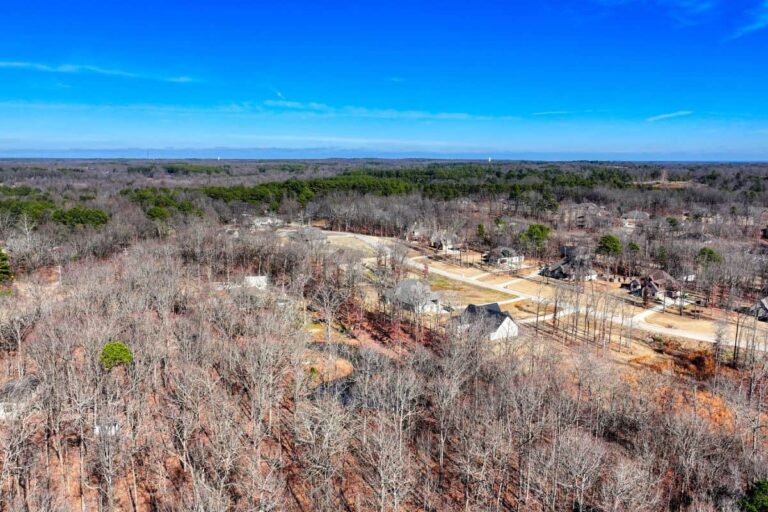
When you evaluate duck hunting land for sale in Arkansas, water drives most of the value. Confirm how water gets onto the tract, how it drains off, and who controls it. Then check timber health, legal access, flood and wetland rules, and the equipment it takes to run the place each season. This guide’s checklist covers each step before you sign anything.
Key Takeaways
- Water control (wells, relift pumps, levees, and structures) matters more than total acreage.
- Flooded red oak timber and moist soil habitat attract ducks, but timber health depends on when and how long water stays on.
- Deeded access that still works at flood stage is not optional.
- Many Delta tracts carry wetland easements or Clean Water Act limits that restrict dirt work.
- Budget for pumping, levee repair, blinds, and road upkeep every single year.
- Verify boundaries, title, leases, and timber or mineral rights before closing.
What buyers look for in Duck Hunting Land for Sale in Arkansas?
Arkansas sits in the heart of the Mississippi Flyway, and the eastern half of the state, from the Grand Prairie around Stuttgart to the White and Cache River bottoms, is where most serious duck property changes hands. Buyers searching for Arkansas duck hunting land for sale usually rank features in this order:
1. Reliable water, either natural overflow from a river or bayou, or wells and pumps that flood fields and timber on schedule.
2. Habitat: flooded bottomland hardwoods, harvested rice or soybean ground, and moist soil openings full of natural seed.
3. Location near refuges, rest areas, and large public areas such as Bayou Meto WMA or the Cache River and White River refuges that hold birds in the area.
4. Access that still works when the whole bottom is underwater.
5. Low hunting pressure on the neighboring ground.
If you are still comparing property types, our statewide guide to land for sale in Arkansas explains how hunting tracts differ from pasture, timber, and residential acreage.
| Region | Typical duck land | What to watch |
| Grand Prairie (Arkansas, Prairie, and Lonoke counties) | Flooded rice fields, pit blinds, well water | Pumping costs, shared wells, crop lease terms |
| Lower White and Cache River bottoms | Natural overflow timber, greentree style holes | Flood timing is outside your control; access during high water |
| Northeast Delta (Jackson, Craighead, Poinsett, and Mississippi counties) | Mix of farmed ground and timber along bayous and ditches | Drainage district rules, wetland easements |
| Southern river bottoms (Ouachita, Saline, and Red rivers) | Oxbow lakes, sloughs, cypress and tupelo brakes | Fewer large holdings; verify legal access carefully |
What land features should you evaluate?
How do water access and water control work on the tract?
Ask the seller to show you, on a map, every way water reaches the property and every way it leaves. Then ask who owns each piece of that system.
| Water source | How it works | Questions to ask |
| Natural overflow | A river or bayou backs up into the timber | How many seasons out of ten does it actually flood during duck season? |
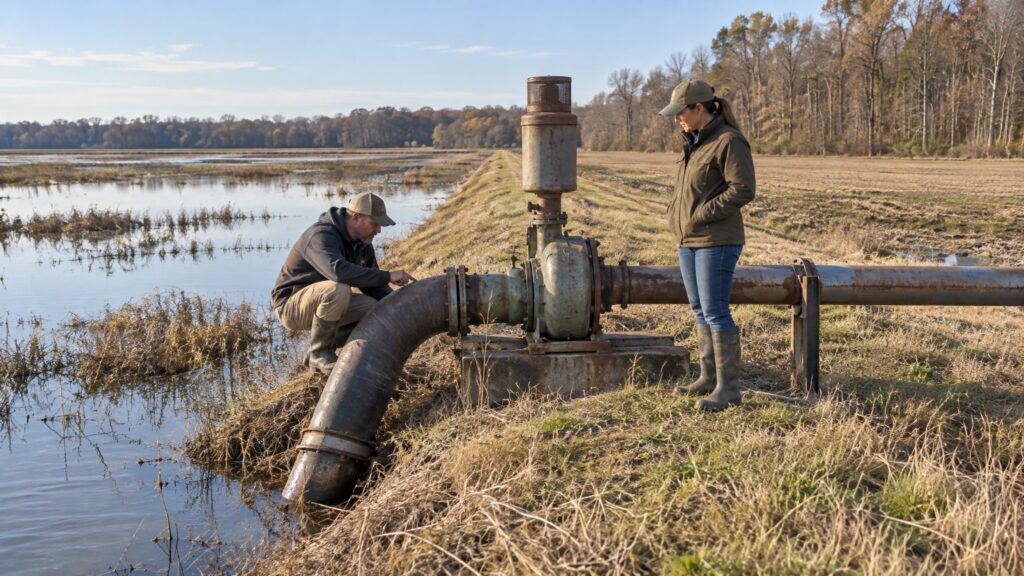
| Well and lift pump | Pumps groundwater or ditch water over a levee | Age of the well and pump, gallons per minute, fuel or electric, and whether it is registered |
| Water control structure (flashboard riser or screw gate) | Holds water on or lets it off | Condition, who has the right to open it, and where the water goes downstream |
| Drainage or irrigation district | District ditches move water across many farms | Annual assessments and district rules on holding water |
On tracts we have reviewed around Newport and across the Grand Prairie, the pump and levee system is usually the most expensive asset on the property and the one most likely to be undocumented. A well that sits on a neighbor’s parcel without a written agreement becomes a problem the day that neighbor sells. Our seller’s guide to valuing water access on Arkansas acreage explains how buyers price these features.
What timber, habitat, and cover should you look for?
Ducks want food and loafing cover. In Arkansas, that usually means:
- Red oak species such as willow oak, Nuttall oak, water oak, and pin oak that drop small acorns ducks can swallow.
- Moist soil plants such as smartweed, millet, and sprangletop in managed openings.
- Harvested rice or soybean fields with waste grain left on the ground.
- Buckbrush and buttonbush thickets that give birds shade and shelter.
Walk the timber in summer, not just in season. Look up at the crowns. Trees flooded too early or held underwater too long each year show thinning tops, dead limbs, and sprouts along the trunk. The Arkansas Game and Fish Commission has shifted its own green-tree reservoirs toward later flooding and earlier drawdown for exactly this reason. A private tract with the same stress signs may need several years of rest before it hunts the way the listing promises.
How much acreage do you need, and what about the neighbors?
A well-placed 40- to 80-acre hole with controlled water can hunt better than 500 acres of dry timber. What matters more than the raw number:
- Enough ground to rest part of it so birds keep using the tract through the season.
- Who hunts the neighboring fields. A nearby refuge or a neighbor who rests birds helps you. A neighbor running a commercial operation with daily pressure does not.
- Whether adjoining farmland is changing crops or drainage. A new ditch next door can pull water off your timber.
- Planned land use. Ask the county about levee, highway, pipeline, or solar projects on adjoining parcels.
How do you verify legal access, easements, and boundaries?
Duck land is often reached by field roads, levee tops, or a neighbor’s turnrow. Many of those routes are permissive, not deeded. Before buying hunting land for sale in Arkansas, confirm the following:
- Deeded access or a recorded easement from a public road to the parcel, not a handshake.
- Whether that route is usable at flood stage or whether you will need boat access part of the season.
- Easements that cross the tract: pipelines, power lines, drainage district rights-of-way, and flowage easements held by the U.S. Army Corps of Engineers.
- A current survey. Corners in the bottoms are often lost, and old fence lines rarely match the legal description.
Our guide to identifying and managing easements on Arkansas property shows how to read recorded easements before you make an offer.
What should you check about flooding, wetlands, and land-use rules?
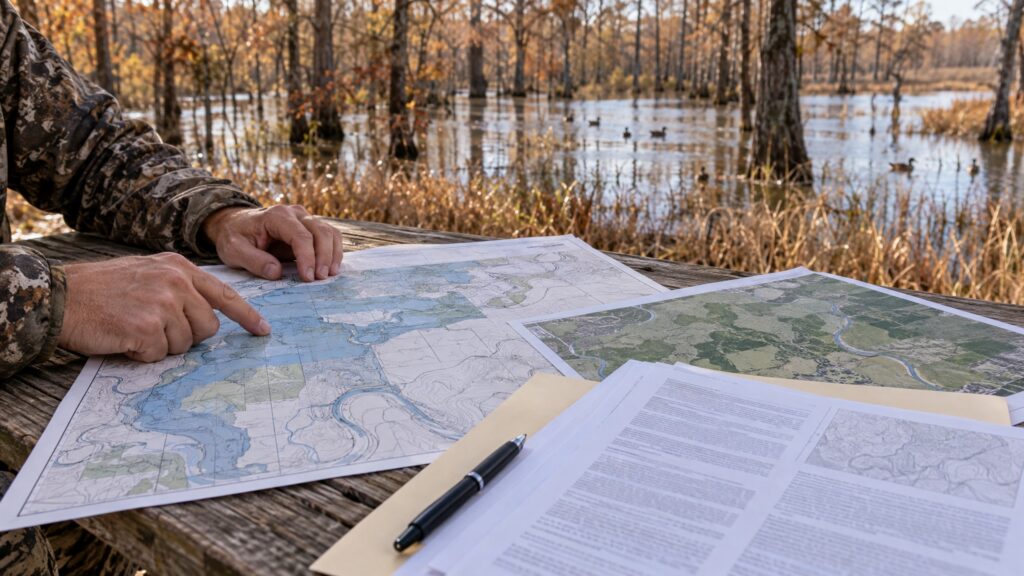
Wet ground is the point of duck land, so the question is not whether it floods. The question is what the rules allow you to do.
| Check | Where to look | Why it matters |
| FEMA flood zone | FEMA Flood Map Service Center | Shows how deep water gets and affects insurance on any cabin or shop |
| Wetland mapping | USFWS National Wetlands Inventory | Flags areas likely to be regulated wetlands |
| Clean Water Act Section 404 | U.S. Army Corps of Engineers district office | New levees, ditches, or fill in wetlands usually require a permit |
| Conservation easements (WRE or WRP) | County deed records and USDA NRCS | May prohibit farming, building, or new dirt work while still allowing hunting |
| Timber deeds and mineral reservations | County records and a title search | A prior owner may still hold the right to cut timber or drill |
| Existing hunting and crop leases | Ask the seller for written terms | Leases can survive the sale for the current season or longer |
Many Delta tracts were enrolled in the Wetlands Reserve Program in the 1990s and 2000s. Those easements are permanent and run with the land. They don’t stop you from hunting, but they can stop you from building a new levee or clearing a food plot, and some management work requires agency approval. Read the recorded easement document, not just the listing summary. Our seller’s guide to floodplain maps and Arkansas land value covers how to pull and read the FEMA panel for a parcel.
What equipment and maintenance does duck land require?
Treat duck property as a working farm, because it is. Typical annual items include:
- Pump fuel or electricity for flooding and drawdown, often the largest line item on pumped tracts.
- Well and pump service, plus eventual replacement.
- Levee and water control structure repair after high water.
- Pit blind pumping, cleaning, and lid or cover repair.
- Road, culvert, and gate maintenance.
- Boat, ATV, or side-by-side access and secure storage.
- Mowing, disking, or planting moist soil units in late summer.
- Property taxes, insurance, and any lease or drainage district assessments.
Ask the seller for two or three years of actual receipts. If the pump was replaced, ask for the invoice. If a levee blew out in the last big flood, ask how it was repaired and who did the repair.
What is the due diligence checklist before buying duck hunting land in Arkansas?
6. Visit twice: once in duck season to see water and birds, once in summer to see timber health and dry ground.
7. Map every water source and confirm who controls each well, pump, and structure.
8. Confirm deeded access that works at flood stage.
9. Order a survey and compare it to the deed’s legal description.
10. Run a title search for liens, back taxes, timber deeds, mineral reservations, and easements.
11. Pull the FEMA flood panel, wetland inventory map, and any NRCS easement records.
12. Review all hunting leases and crop leases in writing.
13. Inspect pumps, wells, levees, structures, and blinds with someone who runs them for a living.
14. Collect maintenance receipts and utility bills.
15. Talk to the neighbors and the county road department.
This article is general education, not legal advice. A local real estate attorney or title company can review your specific tract.
Frequently Asked Questions
How many acres do you need for duck hunting land for sale in Arkansas?
There is no minimum. A 40- to 80-acre tract with controlled water, good cover, and rested neighbors can support good hunting. Larger tracts of 200 acres or more give you room to rotate holes and rest birds, which keeps ducks on the property longer.
When is duck season in Arkansas?
The Arkansas Game and Fish Commission sets dates each year. Regular duck season generally runs from late November into late January in split segments, with special youth, veteran, and active duty hunt days around it. Always confirm current dates and regulations on the AGFC website before planning a purchase around the season.
Can I build a new levee or dig a new hole on wetland property?
Often not without permits. Dirt work in regulated wetlands usually needs a Clean Water Act Section 404 permit from the Corps of Engineers, and a recorded conservation easement may prohibit it outright. Check both before you count on improvements.
Does Veteran Land Buyers purchase duck hunting land?
Yes. We buy hunting and recreational property across Arkansas as is, including tracts with wetland easements, flood exposure, aging pump systems, or unresolved access questions.
Do you own hunting or recreational land in Arkansas and are you ready to sell?
The closing date depends on several factors, including the land title status, document review, and required paperwork. Once we confirm clear title, the process may take about 3–4 weeks.
Veteran Land Buyers is a veteran-owned land company based in Newport, Arkansas. We buy duck holes, timber bottoms, and recreational acreage directly for cash, with no commissions, no showings, and no requirement to fix levees or pumps first. If your tract has an old lease, back taxes, or a wetland easement, we can still make an offer. Learn how the process works in our guide to selling land in Arkansas, or call (870) 533-5263 to speak with our team. Se Habla Español.
Veteran Land Buyers · 416 2nd St, Ste G, Newport, AR 72112 · (870) 533-5263

JP Kilduff is the Co-Founder and Chief Operating Officer at Veteran Land Buyers. He started investing in to real estate and communities in 2016. He has worked with hundreds of families purchasing their unwanted land across Arkansas, South Carolina and Florida. When JP is not buying and selling land you can find him on the local basketball court or playing disc golf.